

Zendesk's buying, Intercom's raising, Meta's cutting, Bluesky's growing, and Digg is dying. It's fine. Everything's fine
In this issue
In this issue
News from Around Supportlandia
Go Bot or Go Home
Big news in big CX companies making big bets on AI.1
On Tuesday, Zendesk announced a definitive agreement to acquire Forethought — an agentic AI company that has been building since 2018, back when the idea of AI handling customer service autonomously was considered, as The Next Web put it, "ambitious to the point of eccentricity."2 3 Price was not disclosed, which is very on-brand, but this is reportedly Zendesk's largest acquisition in two decades. The deal is expected to close by the end of March.
The reason Zendesk wants Forethought isn't hard to understand: the startup's core capability is what it calls self-improving AI — agents that detect gaps in existing workflows and generate new procedures to address them, without any human having to go back in and retrain the model. That's a meaningful leap beyond "chatbot answers FAQs." Zendesk is betting explicitly that its customers want AI agents to handle customer service interactions rather than humans, and the Forethought acquisition is how they're trying to win that bet.
It also goes to pattern: rather than build something in-house that would have to compete in the space with other CX players, Zendesk just acquires those players instead. Zendesk is claiming that Forethought will continue being Forethought:
Forethought customers can expect uninterrupted service and continued product innovation, which will be backed by Zendesk’s global scale. Zendesk customers will gain access to expanded AI capabilities, improved support, and a more unified experience. Additionally, new customers will be able to adopt the solution independently with no requirement to use the Zendesk platform.
But given their history, I’m skeptical. We all know Klaus crossed the rainbow bridge to be absorbed into Zendesk, gone forever as the much-beloved brand we knew. I hope they’re telling the truth about their plans for Forethought, but we’re talking private equity here. PEs aren’t exactly known for their stability and trustworthiness.
Meanwhile, Intercom CEO Eoghan McCabe announced that Intercom raised $250 million — in debt, not equity, a distinction he was at pains to make very clear — to go even harder on Fin, its AI customer agent. McCabe's post announcing the raise is the kind of hyperbolic "anything your AI can do ours can do better" argument that is either very motivating or very exhausting to industry readers, depending on one’s mood (and if you’ve read anything else from me this week, you know my mood was poor, so…deduce from that what you will).
McCabe also says Intercom is planning 650 new hires globally this year, which I personally think is a savvy move alongside their doubling down on AI, given the very understandable anxiety in our field about said AI all but replacing humans in CX (although that may be the cynicist in me talking). I’ll be watching to see if they follow through.
So: two of the biggest players in CX tech are both making massive, public, this-is-the-moment bets on agentic AI in the same week.4 I want to be careful not to just nod along, because we've been here before — the Klarna chatbot that was supposedly doing the work of 700 people until it wasn’t, the AI math that just isn’t mathing. But these aren't startups just making noise to attract funding. These are real companies with real customers making real capital decisions. That's a different kind of signal.
And then, just to keep things interesting: Reuters reports that Meta plans to lay off 20% or more of its workforce, partly to offset the costs of its AI infrastructure bets and to prepare for efficiency gains from AI-assisted workers. So while Zendesk and Intercom are pouring capital into AI, Meta is cutting humans because of it. The agentic era is expensive on both sides of the ledger, and, either way, it looks like we humans are the ones paying for it.
Finally, speaking of signals — it hasn’t escaped my notice that AI has been the main story in the Roundup in some fashion for four frickin weeks in a row. If anything shows how inescapable it’s becoming, it’s this AI-skeptic being forced to cover it nonstop, mostly against her will. What fun I’m having.
This is fine
I know we already have a hefty main story this week, but Toni Schneider was announced as interim CEO of Bluesky this past Monday, and I could not let that go unnoted.
Schneider is the former CEO of Automattic — the company behind WordPress.com, Tumblr, and a genuinely remarkable run of drama that I have covered extensively in this newsletter. If you need a refresher: Matt Mullenweg spent the better part of the last two years lighting his own reputation on fire in a series of escalating conflicts stemming from behavior I can only describe as profoundly unhinged for someone running any company, let alone one with the influence and impact of Automattic.
Schneider, notably, was the adult in the room as interim CEO of Automattic at the beginning of said unhinged behavior, which resulted in exactly zero consequences for Mullenweg, so I have to question how much of an adult he really is.
I mention this because Schneider is taking over for Bluesky's founding CEO, Jay Graber, who is stepping back to become Chief Innovation Officer, and the board has brought Schneider in to navigate what she's calling the platform's "next phase of growth."
Graber notes that both Automattic and True Ventures (Schneider's VC firm) are investors in Bluesky, so this isn't a cold hire, but I have to say I found the way she phrased it deeply ironic, given Mullenweg’s shenanigans:
Both Automattic and True Ventures are also investors in Bluesky, and support the development of a more open, user-driven internet.
Automattic is so supportive of a more open, user-driven internet that its CEO tried to shake down a major player in the open-source world in exchange for letting them continue to contribute to his chunk of it, and personally harassed a user on two platforms for being mean to him. Okay!
I also struggled to get through Schneider’s announcement of his new role with a straight face, particularly these bits:
I’ve spent most of my career working on open platforms, from WordPress and Automattic to the Yahoo Developer Network and to open marketplace businesses like Bandcamp that we backed at True. What I’ve learned is that openness is not just a technical choice, it’s a philosophical one.
Oh is it, Toni? How about accountability? Is that a philosophical choice?
Decisions about who controls the network, who owns the data, and who captures the value shape what the internet becomes.
Boy does it!
Anyway! What was I saying? Oh, right. This is a strange, borderline satirical ouroboros of the open-web ecosystem. The man associated with keeping one open-platform company (Automattic) from completely imploding is now at the helm of the open-platform company (Bluesky) that rose in part because another open-platform company (X) imploded. I’m sure it’ll be fine.
The end of an era (for real this time?)
Digg — a community link-sharing site that predated Reddit and then was usurped by it — announced this week that it's laying off a sizable portion of its staff and shutting down its app as the company rebuilds. Kevin Rose, who founded Digg in 2004, is returning to work on Digg full-time.
The startup says it's not closing, and I want to believe them, but reading this news feels akin to watching someone try to restart a car that hasn’t run in fifteen years. They’re not wrong in saying that the internet is just not what it was when Digg was in its heyday; that era we loved just might be over. But who knows — maybe Rose and Digg will figure it out and bring back those bygone days when we just shared things on the internet for the love of it, without algorithms and spambots stalking our every move.
One last thing: Rose also happens to be an advisor to True Ventures, the VC firm where Schneider is a partner. Sometimes it hits me how much of our internet is influenced (and, in many ways, controlled) by the same small group of people. The same people complaining about the enshittification of the internet are often the ones contributing to it.
An ourobouros, indeed.
And Now for Some Good News
- Nicole Bulman was promoted to Patient Collection Specialist at Spring Health.
- Emilie Glavin was promoted to CX Manager at Ritual.
- Katy VanVliet was promoted to Chief Experience Officer at ReUp.
- Teisha Hillmon renewed her Social Media Marketing certification from HubSpot Academy.
- Drew Clark is celebrating 9 years at Workwell Technologies. Nine years! That's not tenure, that's a commitment.
Read, Watch, and Listen
Read
Ines van Dijk launched the Customer Support Research Lab newsletter and is calling for research participants for the first study on what she calls "asymmetric face exposure," the structural phenomenon in which support agents routinely absorb face damage from customers with no institutional mechanism to acknowledge or repair that damage. The survey is open now - if you've worked in support in the last five years, go take it. This is the kind of research that could really impact (and, I think, improve) conditions in our field.
Miles Goldstein wrote about suspension of disbelief, using theatrical concepts as a lens for navigating corporate communication, crisis management, and knowing when to trust your gut.
Nivedha Venkatesh wrote about why Zendesk Help Center still can't do Find & Replace — and why AI-powered help center maintenance is one of the hardest problems in docs.
Lorikeet released a free set of CX tools and calculators, including a buy vs. build ROI calculator and a knowledge base quality tool.
Ori Lotan wrote about the hidden cost of AI's confident wrongness — specifically, when it sends you chasing features or UI elements that no longer exist, with exactly the same confidence it uses when it's right.
Watch
Conor Pendergrast walks through building a Fin Procedure in Intercom from scratch in the latest episode of Support Stack Solo — specifically turning Fin into a qualification concierge that asks targeted questions, stores structured lead data, and routes to the right next step.
Listen
Natasha Puckett launched CX Unscripted, a new, no-fluff podcast for CX leaders, with its first episode out in April. Keep an eye out for it!
Happy to Help talked to Melody Wilding about psychology in the workplace — specifically, why high-performing support professionals often struggle with people-pleasing, how to set boundaries without losing empathy, and practical mental frameworks for handling pressure and difficult conversations.
Customer Support Leaders talked to Hilary Dudek about the roles AI is actually creating in support — a calming and useful counterpoint to all the "AI is replacing everyone" discourse.
Women in Customer Success sat down with Tamara Kempf to talk about a career built on curiosity, grit, and the kind of EQ that technology can't replace. Another nice palate cleanser after a week of aggressive AI news.
Upcoming Events
A CCO’s view: How Ironclad elevates CX through B2B support
March 17 at 12pm ET. Online event hosted by Customer Success Collective. Register here.
Customer Success Conversation & Connection
March 18 at 5:00pm GMT, Market Halls Paddington, London, UK. Hosted by Angela Scott. Get on waitlist here.
Success Amplified: At The Top
March 25 at 1:30pm EDT in NYC, NY. Executive forum hosted by Women of Customer Success. Keynote by Cassie Young. Get tickets here.
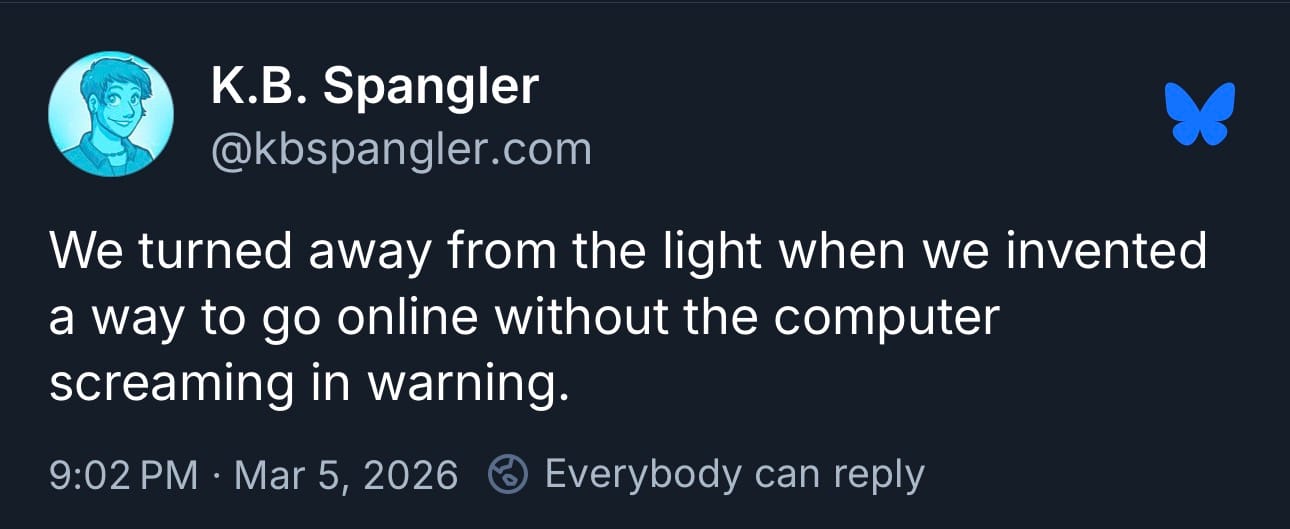
- I’m sorry, I couldn’t help myself.
- If you check out TechCrunch’s article, you’ll see ElevateCX favorite and Forethought co-founder Deon Nicholas’ face splashed at the top. Holy shit, Deon, you’re famous!
- Also, TechCrunch correctly points out how far ahead of its time Forethought was in noting that ChatGPT didn’t launch until 2022. That’s wild!
- Oh, do I long for the day when I could pretend “agentic AI” was just an annoying, made-up term for a very advanced next-word predictor.
Read it here, or have it turn up.
Here on the site, in your inbox, or by RSS. Same issues, no wall, no schedule.
Comments
Something off in this thread? Send me a note and say which post it's on.
More from The Roundup
All of it is free.
None of it is free to make.
No sponsors, no ads, no paid placements, no affiliate links. It runs on a day job and on whoever feels like chipping in.
Read who pays for thisSupport if you can, don't worry about it if you can't. Support Human is for you either way.
Before you post
Disagree with me all you like — that's half the point. Don't come after other readers, don't post anyone's private details, don't pitch anything, and don't post anything you didn't write yourself. I delete what breaks that and I don't argue about it. Full version →