

Same issues. Now with my actual voice.
The podcast is the audio version of the newsletter, read by me (Steph). If you'd rather take it in on a commute or while doing the dishes, this is for you.
Not every issue has an audio version; they go up as I can record and produce them, which takes a while.
Episodes
3 so far · more comingIn today's issue:
Hey, this is our first Bad Job Bingo-only newsletter! I took y’alls advice and decided to stick to a weekly schedule for BJB, and then do commentary as I’m inspired.1
Also, I’ve decided to make all of you members of the Bad Job Bingo Shitposting Focus Group. Welcome! I’m working on making a ridiculous digital badge for you to enjoy as part of your membership.2
You’ll notice that today’s issue is sponsored. This was unexpected, but Mood Gummies seems hilariously appropriate for a newsletter in which a frequent tag is I am a serious professional.
This may be a one-time thing — I guess we’ll see how this issue goes. Either way, thanks for reading today and checking out our sponsor; your interest helps me continue to write Support Human.
Get Hired
I play Bad Job Bingo with every job listing that appears in the Roundup and categorize them according to how well (or poorly, if I hit Bingo) they do in the game.
However, please remember that a job appearing in a positive category isn’t an endorsement of any role or company, and a job appearing in a negative category doesn't mean I think you shouldn't apply if it works for you. Bad Job Bingo is simply an effort to give you a shortcut to finding roles that may match your needs and values.
These and more Bad Job Bingo-rated jobs can be found at Support Human Jobs.
Green Means Go
No flags, or green flags only! A true unicorn.
Customer Success Operations Manager
Clio · $86k-$107k · Remote, CAN-Calgary, Alberta; Vancouver, British Columbia; Toronto, Ontario; United States
Application is on Workday. My condolences.
We aim to hire all candidates between the minimum and the midpoint of the full salary range. We reserve the midpoint to the maximum of the salary band for internal employees who demonstrate sustained high performance and impact at Clio.
This is the first time I've seen a salary note like this and I actually really like it.
Assuming this isn't just for show and they really are rewarding existing employee work and loyalty, it seems like a green flag to me. Overall, this is a clear job description and I see nothing but positive culture signals, so I'm throwing this in Green Means Go!
Eh, It’s Probably Fine
A few flags popped up, but no serious ones.
VP, Global Customer Support
Zuora · $240k-$360k · Remote, US
No major flags, Zuora seems to have a good grasp of what they want this position to accomplish, and the salary is excellent. Happy to put this in Eh, It's Probably Fine!
Director, Global Customer Support
Oracle · $139k-$292k · Remote, US-Columbia, MD
Seems fine. Sounds like a very call center-y, corporate role, which is fine if that's your thing. Benefits seem good, pay range is good (if broad).
Lots of other Support roles (over 100) on the Oracle jobs page, some remote, most local.
Senior Director, Customer Support
Clio · $117k-$146k · Remote, US
Overall, while I don't think there are any major flags, the USD salary range is a little low for a Senior Director role of this type, so I'm going to put it in Eh, It's Probably Fine.
Senior Manager, Community Support PMO
Airbnb · $185k-230k · Remote, US
Looks like an interesting, meaty role, and I see no major flags. Pay is fantastic.
Senior Manager, Risk and Compliance Operations
Airbnb · $185k-$230k · Remote, US
This role is not a purely CX role, but it does have a clear CX Ops focus, so I'm comfortable listing it here.
Looks really interesting with no major flags. I'm not as qualified to comment on whether the salary is appropriate for this type of role, but from a CX standpoint, it's excellent.
Senior Program Manager, Community Support
Airbnb · $150k-$192k · Remote, US
Role looks mostly fine, save this requirement at the very bottom: Grace under pressure. I know we haven’t gotten there yet, so you’ll have to take my word for it, but: Love how these companies are independently committing to the theme this week.
Again, not enough to throw it into Tread Carefully, I would just recommend following up on it during any interviews.
Investigations & Response Manager, Customer Trust & Privacy
Netflix · $100k-$350k · Remote, US-Los Gatos, CA
Seems like a pretty straightforward role with no major flags. The salary is, of course, Netflix generous.
Player Support Lead
Netflix · $50k-$250k · Remote, US-Los Angeles, CA
The role itself seems fine, but the salary range is very wide, and the low end is way too low for a Lead role (especially at a company like Netflix). I don't think that's enough to put it in Tread Carefully, but I would ask about it if I were a candidate.
Senior Contact Center Operations Strategist
Genesys · $99k-$194k · Remote, US-Colorado; Indiana
Application is on Workday. My condolences.
Seems fine, very corporate, but they're honest about that. Benefits are fine; pay is mostly okay – I think the low end is a little too low for a senior role, but not so low that it's a major flag.
Senior Customer Success Manager
Carrot Fertility · $93k-$120K · Remote, Worldwide
Seems good! No major flags and the benefits are great. Salary seems a little on the low side for a Senior Customer Success Manager, but if it's just a base salary with commission, it could be great.
The position just says remote, so I'm assuming it's Remote-Worldwide. There are several other Success positions in countries around the world on the jobs page.
Voice of Customer Manager
Clio · $91k-$115k · Remote, CAN-Calgary, Alberta; Vancouver, British Columbia; Toronto, Ontario; United States
Seems like a neat role, although I do wish the salary range was higher.
Customer Experience & Service Transformation Management Manager
Accenture · $87k-$259k · Hybrid, US-Certain Cities & States
Application is on Workday. My condolences.
I have no idea whether this job is remote, hybrid, or onsite. I'm going to guess Hybrid since they require "primary residency within 90 minutes of an approved Accenture office."
This job seems fine if very, very corporate, the weirdly wide salary range notwithstanding.
Technical Support Engineer (L5)
Netflix · $100k-$720k · Remote, US-Los Gatos, CA
Seems great, and the salary is amazing.
Knowledge Strategist
Airbnb · $100k-$120k · Remote, US-Certain States
Sounds like a neat Knowledge role, and the pay is great (especially for Knowledge work, which is often undervalued).
Tread Carefully
Didn’t quite hit bingo, but there were several yellow flags or more than one red flag.
Support Team Lead
Arbor Education · $40k-$46k · Remote, UK-Leeds
This job was reader-submitted. Thanks!
I'm torn – it's rare to see salary transparency for international roles, so kudos to Arbor Education for sharing the salary and putting it up front: £30,000-£35,000 (~$39,600-$46,000). However, a lead position at that salary level is not great, and that's even before I look at the JD.
Overall, it's pretty clear they're looking for a discount manager, which is enough to put this in Tread Carefully. There are several other CX positions available as well.
Director, Customer Success
Qualio · "Competitive," not given · Remote, US
Qualio's Careers page is one of the most informative I've seen – they have a great Interview Prep page and an extensive hiring FAQ.
Man, I really want to put this in Eh, It's Probably Fine, but alas, they claim a competitive salary without then sharing the salary. So – well, you know how this ends.
Senior Manager, Technical Customer Support
Zuora · "Competitive," not given · Remote, AUS-Sydney
Positive attitude and the ability to overcome adversity; ability to stay calm under pressure.
These companies do know that no one's forcing them to build company cultures 20,000 leagues under the sea, right? Come out of the water. It's nicer up here.
Since Zuora seems to only offer salary transparency when they have to, I'm throwing this in Tread Carefully.
Manager, Customer Onboarding
Qualio · "Competitive," not given · Remote, US
Strong ability to de-escalate a situation (internal or external) to create a win-win scenario for both parties
But why would they need to de-escalate situations internally? Yikes on bikes.
Demonstrated ability to work cross-functionally on a common goal while influencing without authority; Adjusts quickly to shifting priorities and conditions; Copes effectively with complexity and change, while maintaining focus on priorities.
Well, we're certainly building a narrative here, aren't we?
This one definitely earned the Tread Carefully category.
Technical Support Engineer – L3
Redis · "Competitive," not given · Remote, UK
There's only one woman in the C-Suite, so it's a double whammy of "all the women on the leadership team are white" and "all the women on the leadership team are from Support, Marketing, or HR."
"Find your voice in bringing our story to the world" rubs me the wrong way, but otherwise Redis has a standard, moderately informative Careers page.
the excitement of helping name-brand customers
Are people really excited by this? I might be too jaded for this job description. Sorry, Redis.
In this role, you will use and extend your existing technical depth and increase your technical breadth by addressing complex problems for the top companies in the world.
I really like this phrasing. It respects a candidate's existing knowledge while emphasizing that growth will be needed.
You will level up to be an expert complex problem solver on Redis Enterprise Software, being used as a high-performance database by thousands of worldwide customers.
Okay, I was all ready to be outraged by this weird dehumanization, but thankfully the Bad Job Bingo Shitposting Board of Directors pointed out that it's just a poorly constructed sentence. Now it's just very funny uh-oh.
We are looking for brilliant experts
Dull amateurs need not apply!
High availability and commitment to customers
HMM. Without elaboration, that "high availability" is fishy as hell, y'all.
I understand that it's customary for there not to be salary transparency in international roles, but I refuse to excuse companies simply because they're not required to have it, especially when they claim to offer competitive salaries.
There are a bunch of other TSE roles in various EU countries open as well.
Support Engineer
Zuora · "Competitive," not given · Remote, AUS-Sydney
Careers page is great – informative and easy to navigate.
Our ideal candidate possesses a strong technical background, is a detailed documenter, and is a masterful troubleshooter. In today’s ever-changing social landscape, we need someone up-to-date on the latest and greatest web tools and platforms, able to troubleshoot basic software applications, and an excellent communicator via email or over the phone.
Again, I love it when companies skip the job listing cliches and just describe what they're actually looking for in a candidate. So refreshing!
A self-starter with the ability to work independently, yet able to account for their activity.
This isn't terrible, it just tells me that they're not big on proactive trust, which kinda stinks.
Ability to work independently and be a self-starter.
Okay, we got it. No lazy moochers.
No salary transparency and some interesting culture signals put this in Tread Carefully.
Director of Customer Success
Handle · No comp given · Remote, US
Careers page is fine, if basic. The role seems pretty straightforward and I'm not seeing any major flags.
I wish they wouldn't call benefits perks, but that's a minor crime. I think it would probably be fine, except there's no salary transparency, so into Tread Carefully it goes. Womp Womp.
Technical Support Engineer - UK
Axonius · No comp given · Remote, UK-Leeds
High level of professional resilience to work in a pressurised environment
I appreciate that they're being upfront about this, but it's a bad sign that they have to be. It's our job as leadership to create an environment of respect for our customer support teams among our customers. If things are so bad that you have to specify "professional resilience" in your candidates, that's a failure of leadership and the company, not in potential candidates.
Yep, I'm making that a new Bad Job Bingo entry.
Must be able to have fun in tough situations while working closely with an international Technical Support organization
Woof.
Culture is important to us
Is it, though?
We didn't quite hit BINGO, but this is a solid Tread Carefully.
Lead Knowledge Strategist
Airbnb · No comp given · Remote, Ireland
Would be in Eh, It's Probably Fine if not for the lack of salary transparency. It's your own fault, Airbnb.
Knowledge Strategist (Global)
Airbnb · No comp given · Remote, Ireland
Boo, no salary transparency. Companies should always be transparent, not just when they have to be! I expected better from you, Airbnb.
Premium Support Associate
Airbnb · No comp given · Remote, CAN-Alberta; British Columbia; Quebec; Saskatchewan
They should also be adaptable and responsive in our fast paced environment, sometimes under pressure, while remaining flexible, proactive, resourceful, efficient and demonstrating a high level of professionalism and confidentiality.
This might be the only time this week where it makes sense (and is something of a green flag) for a job description to warn about needing to be able to function under pressure. I imagine supporting guests in luxury Airbnb accommodations can be very high-pressure at times (although I wish it weren't).
This is a very well-written job description authored by someone with a deep understanding of the Support function at Airbnb. It focuses on key duties and, in doing so, helps candidates understand exactly what they'll be doing in the role (so they know if it's a good fit or not). Kudos to the hiring manager and/or whoever wrote this.
As much as I'd like to put this in Eh, It's Probably Fine, I can't because there's no salary transparency. A solid JD is only part of the overall package; a big part of a candidate knowing if a role and company are going to be a good fit is being able to determine whether they're going to be adequately compensated for the work they'll be doing.
Not being clear about this upfront wastes everyone's time and demonstrates a lack of respect for a candidate's experience. (This is true regardless of where in the world the role is based.)
All that to say: show me the money, Airbnb.
BINGO
Welp.
Surprisingly, none this week.
Seriously, Maybe Don’t
Don't say I didn't warn you.
Director of Support
PeopleGrove · No comp given · Remote, US-Arlington, VA
Okay, the Customer Success Manager role was a bit of a stinker, let's see how this one goes.
Role Description: 40% Individual Contributor | 20% People Management | 20% Project Management | 20% Strategy
I'm all for staying close to the customer, so I'm trying to figure out why this bugs me. Maybe it's because I'm trying and failing to think of any other kind of role in which a company would type something like this out. I don't see a Director of Engineering being described as a 40% individual contributor or, as the BJB Shitposting Board pointed out, having their work so specifically divvied out for them before they ever step into the role.
You’ll have a voice and a seat at the table in shaping our support and onboarding strategy.
Unless you're reporting to a VP of CS/CCO, this feels like a major red flag. If you're the Director, why aren't you the one designing and driving the strategy?
I don't think they really know why they're hiring a Director of Support, which will likely make actually working in this role unpleasant, to say the least. I'm putting this right next to this company's other role in Seriously, Maybe Don't.
Customer Success Manager
PeopleGrove · No comp given · Remote, US-Arlington, VA
Careers page looks great – and they offer pet insurance!
Passion for supporting the mission of higher education.
Sure, but I'm speaking from experience here: mission juice will not pay your bills or feed your family. Edtech is especially bad about bleeding their people dry in support of the mission, so just...be careful. My alarm bells are ringing.
Comfortable with taking risks, leading and working through ambiguity, and challenging assumptions to develop and deliver optimal solutions for customers.
Boy, those alarm bells are getting loud. I don't even know what this is supposed to mean, but you should NEVER EVER take on risk on behalf of the company employing you unless you're, like, a firefighter or something. Which this is very much not.
Yeah, I was gonna put this in Tread Carefully, but not anymore! Seriously, Maybe Don't it is.
(Oh god, do I need to start counting pet insurance as a red flag? Why, hiring managers, WHY?)
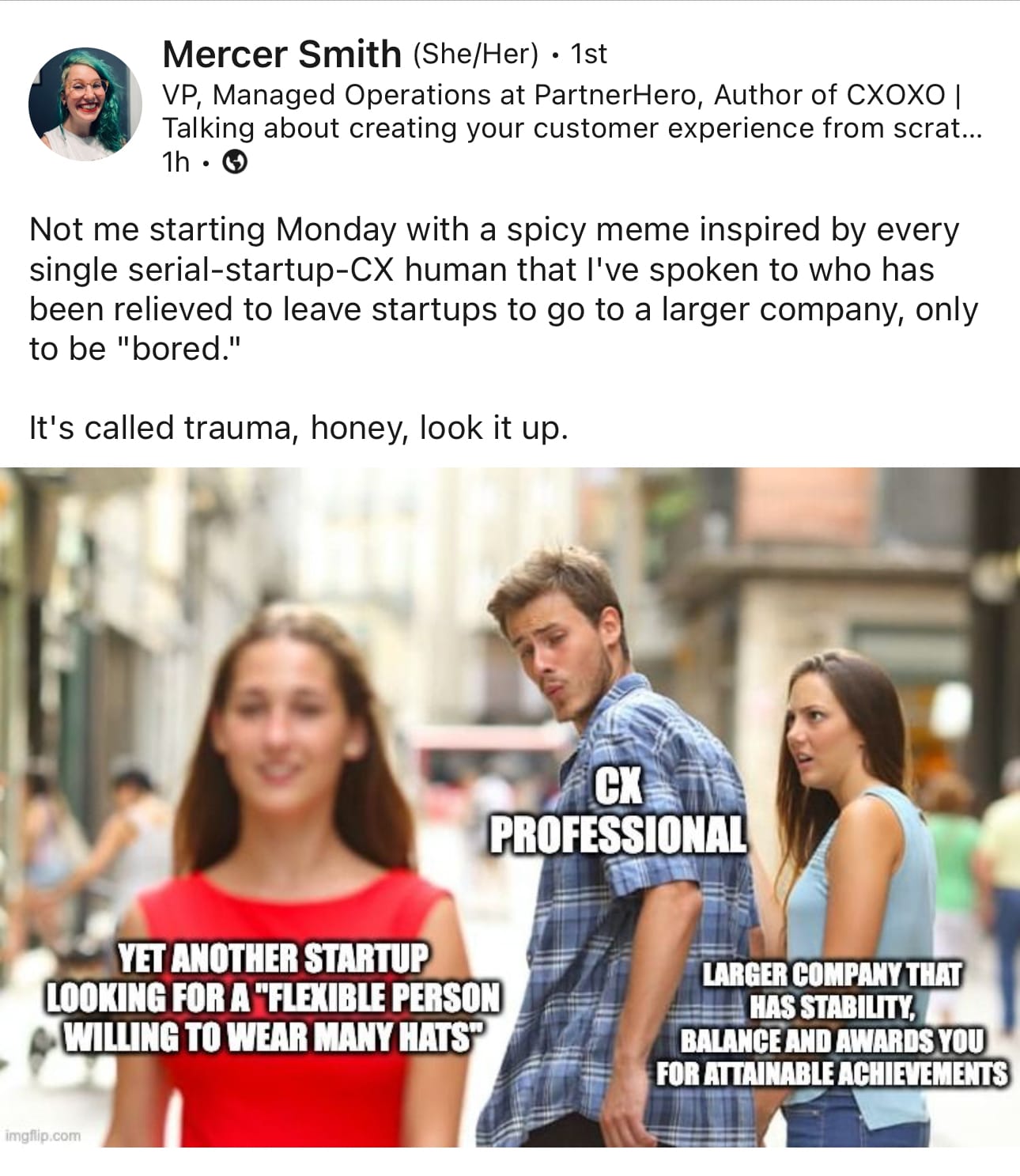
- Thank you all for the lovely comments in the poll, by the way. It’s easy to feel like I’m screaming into the void, and even though I’m happy to be known for that, it’s nice to remember I’m not screaming alone.
- The group chat still exists; they’ve been appointed to the Bad Job Bingo Shitposting Board of Directors.
We’re in a theater and this is all a play.
In today's issue:
- Exit, Pursued By A Bear
- And Now for Some Good News
- Get Hired
- Green Means Go
- Eh, It’s Probably Fine
- Tread Carefully
- BINGO
- Seriously, Maybe Don’t
Exit, Pursued By A Bear
If you follow me on LinkedIn,1 you know there’ve been a lot of changes over the past few weeks.
(For instance: if you hover over the footnotes, they’ll pop up so you can read them right where you are in the text.)
I’d like to say that all of these changes were planned in a mastermind fashion and expertly executed without issue. I’d love to say that. Can I say that?
Uh, no. I cannot.
One of the wonderful things about doing this newsletter is that it helps me connect with people. I’ve spoken with a few people about the work I’m doing face-to-face and with more passingly on social media,2 and I love it every time. But lately, it’s made me worry.
I wonder what people see when they watch me publish this newsletter, run the Jobs board, the Resources site, or, as I started recently, the podcast. It’s work, I think that much is obvious to most people. But outside of that, I worry that I’m projecting an image about all this stuff that just isn’t accurate.
I don’t think anyone considers writing a newsletter glamorous, but I do think there’s just enough mystery surrounding it that it seems like something one might breezily pick up for fun and profit.
And I’m not saying it isn’t fun — my ADHD wouldn’t allow me to do any of this if it wasn’t novel or fun in some way — but if you’ve read this newsletter or Bad Job Bingo and found it to be of any quality standard above “not reminiscent of garbage in an alley after it’s been cooked in the heat of a Texas summer,” let me just say: insert relieved laughter followed by incoherent sobbing here
It is those things, but it’s also…much more than that.
For one, it’s exhausting. It’s an exhaustion I picked! But when I’m on a break from my full-time job, I’m writing. That last issue about Andreessen and Horowitz’s endorsement of Trump? That was three solid days of researching and writing every moment I wasn’t working or sleeping (when I slept, which wasn’t much).
If I want to publish on time, then at night after work I’m on the couch, half-cuddling with a kid and half-rating jobs for Bad Job Bingo. On weekends I’m in my office, updating the job board and the Resources site, putting together the newsletter. I record podcast episodes when my kids are asleep and the house is quiet. Sometimes, I’m typing away in bed while Mr. Steph sleeps.
There’s no getting ahead with this kind of work. If I take a day off, I feel guilty for not hustling more, and that’s one day later the newsletter goes out, which means I can’t publish consistently, putting a successful newsletter that much farther out of reach. If I work whenever I can, I feel like a terrible parent, sacrificing precious moments with my kids for something that may or may not ever be worth it.
Also, not for nothing, but I have no idea what I’m doing. Seriously. If I’m not making shit up or trying to figure shit out, I’m fixing shit I broke. If I really fuck up – like, say, messing up my Stripe account so that subscribers can’t support me3 – then that’s less money that I can depend on to pay my bills, which means I have to take on outside freelance work, which means I can’t publish consistently, putting a successful newsletter that much farther out of reach.
Hey, speaking of money, I’m not making any. I mean, hopefully I will at some point! But the costs of operating the newsletter, the job board, and the Resources site are currently higher than the income they’re bringing in.
Again, this isn’t me complaining – I’m choosing to do this! It’s also not a guilt trip or a money-grabbing strategy – I’m intentionally doing things that I knew would be hard and wouldn’t have traditional revenue streams.
What it is is reality.
I worry that by not talking about how hard all of this is, how chaotic it actually is behind the scenes, folks who are trying it themselves (or anything new) will look at me and wonder what they’re doing wrong. I’m managing to do so much, so why do they feel like imposters on top of not making any money and feeling like shitty parents and shitty partners?
It’s because we’re in a theater and this is all a play, except I’ve neglected to tell you what I’m acting out. It’s Shakespeare! So highbrow! But oh no, it’s The Winter’s Tale, and I’m Antigonus, my business is the baby, and real life is the bear waiting to chase me offstage to my demise.4
Also I have good news for anyone who feels like this in their job, too, because it’s not just the newsletter. I found myself asking the universe this week: how does anyone ever feel like an expert at anything?
I only seem to find ever more challenging work, and I think, it’s fine! This is good! If I can do this, I can do anything! And yet, no. The next thing is just a different, harder thing.
For me, searching for expertise is like diving into a well and trying to find the bottom. Despite my inefficient dog-paddling, I do get deeper! But the water just gets darker, and colder, and the bottom never appears.
So like. If you’re going through life and encountering nothing but hurdles when it seems like everyone else is leaping like perfect, graceful gazelles5 over them, let me just lower the bar for you.
No, lower.
Lower than that.
Oh, is it on the ground? Great, because that’s where I am. Don’t worry, I face-planted, but I’m still breathing. Just give me a minute.
Anyway. Changes. Right.
For starters, you’re probably going to start seeing ads in the newsletter (unless you’re a paid member, in which case you shouldn’t see anything!).6 I would love to be solely reader-sustained, but I also need this work to be sustainable in general. To do that, I need to be able to fund it. Thus, ads.7
I’m able to do this because I moved the newsletter from Ghost to beehiiv.8 Aside from the neat trick with the footnotes, the writing and publishing experience is better for me, and despite the ads, I think it will be a better reading experience for you.9
Here’s a change I’m really excited about: I’m helping the ElevateCX community with their newsletter, and from now on the Good News and the Read / Watch / Listen sections will become a part of that publication. It’s a better fit, and it means I can focus more on the core parts of this newsletter.
Because of that, I’m experimenting with dropping the Roundup from the title of the newsletter and the date from individual issues. Calling it Support Human is easier, makes for better branding, and aligns more with what I’m doing here.
Finally, for possibly the biggest change of all, I need your help, my fellow Support Humans.
You’ve probably noticed that the newsletter gets long. Like, really long. So long that many email clients routinely cut off much of the text, forcing subscribers to finish reading online. It’s probably being clipped right now, in fact. (If so, click Read Online at the top of this email.)
I introduced the Brief to help alleviate this problem, and that’s not going away,10 but it doesn’t really fix the issue for readers of the original newsletter. So, let’s consider some options for a different format / publishing schedule. Then I’m hoping you’ll help me decide by voting for your favorite option.
Option 1: Keep the main newsletter the way it is.
Pros: I wouldn’t have to change anything I’m doing.
As a reader, you get just one issue a week, which is what I promised when you subscribed, and which might be easier for you to keep up with.
Cons: Doing both a main story / news commentary and Bad Job Bingo at the same time makes for a punishing schedule for me because it means I’m updating the job board and the Resources site at the same time. It also makes it more likely that there won’t be a main story, or that there’ll be less Bad Job Bingo, or that there’ll be no new issue at all if I’m having a busy week.
As a reader, you can’t just stay in your email if you prefer that, which might be a nuisance for you.
Option 2: Keep the news/commentary and Bad Job Bingo in one issue, but just link to the jobs (no ratings commentary).
Pros: Each issue would be much shorter, and it would be easier for me to put together the Bad Job Bingo portion of the newsletter. Because issues would be shorter, I could potentially fit in more jobs.
As a reader, you wouldn’t have to leave your email to read an issue, and you could go to only the jobs that sound the most interesting to you.
Cons: This doesn’t really solve my pacing issue, and honestly, it would take away a lot of what’s fun for me about doing the newsletter.
As a reader, if you’re here primarily for Bad Job Bingo, a commentary-only newsletter will likely be a bummer for you.
Option 3: Divide them up! Publish news/commentary in one issue and full-length Bad Job Bingo in another.
Pros: Not to sway you, but this is admittedly my favorite option at the moment. This would solve my pacing problem completely; I could do Bad Job Bingo and update the job board weekly regardless of whether there’s news for which I feel I could offer an interesting perspective. When there is, I can take my time and focus on that without it derailing Bad Job Bingo, as it so often has. (Timeliness to the news notwithstanding, as there’s no way to get rid of that pressure).
As a reader, you get jobs in your inbox weekly with a healthy helping of sass, and every once in a while you’ll still get high-quality commentary on CX and Tech news in a different issue.
Cons: I still have to publish weekly, sometimes more than weekly.
As a reader, if you’re here primarily for the main story/commentary, having a Bad Job Bingo-only issue will likely be a bummer for you. Plus, you’ll potentially have to keep up with two issues in one week, which may not be what you signed up for.
Option 4: Something else I'll explain in the comments.
Have an option I haven’t considered? Let me know in the comments.11
Thanks for the help!
What should the newsletter look like going forward?
- Keep the main newsletter the way it is -- I love a useful monster.
- Keep the news/commentary and Bad Job Bingo in one issue, but just link to the jobs (no ratings commentary).
- Divide them up! Publish news/commentary in one issue and full-length Bad Job Bingo in another.
- Something else I'll explain in the comments.
And Now for Some Good News
Love this batch of folks for the last edition of Good News. Thanks for letting me celebrate y’all here — see you over at the ElevateCX newsletter!
- Rachel Avery earned a Social Media and Social Content Strategy certification from the Digital Marketing Institute.
- Yas Longoria joined Employ as Senior Manager, Customer Success and Support.
- Liz Bunger joined Vertex as a Knowledge Management Leader.
- Jennifer Kyles joined Klaviyo as a Senior Billing Specialist.
- Matthew Doering joined Meta as a Technical Solutions Consultant II.
- Gary Lam joined Inteplast Group as a Customer Service Representative.
- Ian McMullen was promoted to Senior Customer Support and Operations Manager at Retrium.
- Melissa Beringer was promoted to Senior Customer Success Manager at Braze.
Get Hired
I play Bad Job Bingo with every job listing that appears in the Roundup and categorize them according to how well (or poorly, if I hit Bingo) they do in the game.
However, please remember that a job appearing in a positive category isn’t an endorsement of any role or company, and a job appearing in a negative category doesn't mean I think you shouldn't apply if it works for you. Bad Job Bingo is simply an effort to give you a shortcut to finding roles that may match your needs and values.
These and past contestants can be found at Support Human Jobs.
Green Means Go
No flags, or green flags only! A true unicorn.
VP, Customer Success and Technical Operations
HUMAN · $180k-$210k · Hybrid, US-NYC, NY
The Careers page is somewhat bare bones, but otherwise fine. Their values seem honest and in keeping with their brand.
I'm pretty impressed with the job description overall. Aside from a brief reference to "diversity of thought" (which in context seems harmless), they manage to convey the qualities they're looking for without being unnecessarily prescriptive or ableist, they seem to understand well what they're looking for, and the stated goals are unusually grounded for a VP of Success position.
All in all, I think this is a solid Green Means Go.
Eh, It’s Probably Fine
A few flags popped up, but no serious ones.
Senior Technical Writer
Circle · $133k-$170k · Remote, US-Atlanta, GA; Austin, TX; Boston, MA; Chicago, IL; Los Angeles, CA; Miami, FL; NYC, NY; Phoenix, AR; Salt Lake City, UT; Seattle, WA
The Careers page is straightforward, their company values are pretty run-of-the-mill.
I know this is a bit outside Support knowledge work, but I think it'd be a good fit for CX folks. The position seems fine, and the pay is great.
Note: I think the job is probably Remote in the US, but candidates are asked to pick the city closest to them before applying, so I'm putting those cities as the location just to be safe.
Community Manager
Medium · $100k-$150k · Remote, US
The Careers page is straightforward, run-of-the-mill tech company fare.
This seems like a somewhat hybrid role between standard Community work and Support work, which I always enjoy seeing. Given the duties, I do wish this were a more senior title, although the pay is great regardless.
Enthusiasm for building something new, coming up with new ideas, and working autonomously. You know how to engage communities and you have new ideas to bring to Medium that you’ll launch and oversee.
I like the way they phrased this – a thoughtful alternative to the lazy and boring "must work independently."
Proven ability to work collaboratively in a fast-paced, team-oriented environment.
Man, we were so close to avoiding the standard job cliches!
Strong analytical and problem-solving abilities, with a product- and systems-thinking mindset.
You know what, this is also a nice break from the "high intelligence" bullshit I so often see in job descriptions. I know exactly what they're asking for and, therefore, can ascertain why they're asking for it.
Working with a fully distributed team: We’re totally remote and have teammates across the U.S. & France
Sing it with me: this is not a benefit!
Note: This job has closed since I rated it.
Tread Carefully
Didn’t quite hit bingo, but there were several yellow flags or more than one red flag.
Vice President, Customer Support
Billtrust · $200k-$280k · Remote, US
A ping-pong table made an appearance in a company recruitment video. Tsk tsk.
The video is actually pretty cute overall, though. I appreciate that they say they hire "people with diverse backgrounds" rather than "diverse people," and I love the bloopers at the end (I'm a sucker for personality and people obviously having fun). I also think it was great and fairly savvy to note that they only used real employees in the video.
For a larger company (over 750 employees, according to their Careers page), I'm pretty impressed that they've managed to balance the corporate speak with a clear company personality. Of course, it's no substitute for how they actually treat employees, but I appreciate the effort.
The actual job description is significantly more corporate, sadly, which isn't a surprise for an executive role, just a little disappointing.
You will maintain and grow established relationships with both customers and internal leadership alike and will apply your negotiating skills when working cross-organization (i.e. – IT, DEV, eOps, etc.) to facilitate solutions or meet urgent customer timelines.
Eehhhh, this feels like a flag to me. It tells me that Customer Support as a discipline isn't highly thought of in the company, and so you'll spend a lot of your time trying to get other functions in the company to take you seriously and apply their resources for the good of the customer.
You will execute your strategic vision to identify opportunities for enhancing organizational alignment, process efficiency, customer self-service, and employee engagement, while maximizing the cost of support.
Sigh. I wouldn't mind this so much if it weren't always Customer Support getting the directive to maximize costs.
Use skills of persuasion and negotiation to drive positive change for the organization with Sr. leadership
*nervous laughter*
Work with internal support partners to ensure appropriate structure in place between organizations to maximize working relationship
I'm not sure what this means, but it can't be good, right?
Maintain ownership of CS projects and initiatives associated with continuous improvement, cost reduction, monetization, and employee engagement
Because nothing says positive employee engagement like cost reduction and monetization?
Strong senior leadership work ethic with confident decision-making under adversity
WOOF.
Proven ability to lead, succession plan, and inspire a team of managerial direct reports
Wooo, they throw "succession plan" in the middle there so casually, don't they! Tell me there's lots of turnover without telling me there's lots of turnover.
On the one hand, the company has obviously put a lot of effort into thoughtful recruitment and employee benefits. On the other, there are some flags here that I'd ask about – Support's relationship with other teams, Support's relationship with senior leadership, and things like manager turnover (which is often an early warning sign for employee turnover). Good thing we have Tread Carefully!
Sr. Manager, Learning & Quality, Ring Technical Customer Support
Amazon · $121k-$225k · Remote, US
Reading through the job description, the title seems misleading—this feels more like an AI content automation position than a Knowledge & Education one.
For that reason, and because the whole thing feels phoned in at best (you'd think a company with Amazon's resources would be able to put together a reasonably informative JD), I'm throwing this in Tread Carefully.
Anyway - the pay is good, benefits seem good. You'd be working for Amazon.
Product Specialist, Manager (Post Sales)
AlphaSense · No comp given · Hybrid, UK-London
The Careers page is well-developed, informative, and pretty straightforward.
We spend our waking hours obsessing over our customers
Eh, do you though? 'Cause that's not necessarily something I'd brag about.
You demonstrate equanimity in all situations.
This is "stay calm under pressure" in sheep's clothing, in case you were wondering.
You are a warm but demanding manager to your direct reports.
Again, it's not that weird, just a signal of a specific kind of culture, which could be fine! Make sure it's your kind of culture, is all I'm saying.
An intelligent, articulate, consultative and confident client facing professional
No unintelligible, meek boneheads, thank you very much.
Superior ability to develop rapport with people, and to maintain relationships, combined with a positive and proactive personality.
Ah, so we're prescribing personalities now, cool cool cool.
Energetic and creative individual
I'm just a girl, standing in front of a faceless company, asking them to stop saying this ableist bullshit.
Effective attention to detail, time management and task prioritisation, even when under pressure.
I'm not going to copy and paste the typos / errors in this JD (you'll see them below), but there were enough that I thought to myself, "These folks are definitely going to require attention to detail." It's just a constant of the universe now.
I was going to give this an Eh, It's Probably Fine, but the weird culture signals tipped it over into Tread Carefully for me. Oh yeah, and there's no salary transparency (and the application asks for comp range), so that would've done it anyway.
There’s a Product Specialist, Manager (Pre Sales) and a Customer Success Manager (B2B - Presales) open as well (both Hybrid London).
Customer Support Manager
Vetcove · No comp given · Remote, US
Okay, so this is why I keep an archive of roles: back in January, Vetcove put up a listing for a Head of Growth and Customer Experience.
Many of the duties are the same, with some notable updates. Take this duty in the Head G&CX listing:
Manage three customer support managers who each oversee a team of support associates and act as the direct manager for our retention specialist
Now this one from the current listing:
Manage a team of offshore contract support associates, provide training, onboarding, and measure performance
So I'm making some assumptions here, but nothing that's not confirmed by what we've seen in the Customer Support industry as a whole in the past couple of years. It sounds like they laid off what in-house managers and support team they had, including the Director (assuming they ever hired one), and then, of course, brought in the BPO team.
I can give you my professional opinions about this trend (it's short-sighted, destructive to the company and its customers, and ultimately futile as a cost-saving mechanism), but I don't know anything about this company other than what's on their website.
I can tell you that I think they're asking too much from a Manager-level role, and I think the evolution in their Support approach above is a bad signal for the function and the company's future. Tread Carefully.
Associate Customer Success Manager
GitHub · $49k-$148k · Remote, US
Boy, that's a wordy job description. And dense.
Nothing in particular is jumping out at me, but I confess I did skim. Did I mention it's long? Also that salary is as wide as the JD is verbose. One might say comically so.
Product Specialist
AlphaSense · No comp given · Onsire UK-London
This role has the same weird (and ableist) culture signals as the Manager role. Also, there's no salary transparency and the application asks for your target comp range, so into Tread Carefully it goes.
There’s a Product Specialist (Remote US) and a Customer Success Specialist, Financial Services (Onsite London) open as well.
BINGO
Welp.
Technical Support Representative
Drata · $56k-$89k · Remote, US
This one was reader-submitted. Thanks!
I'm on the fence about Drata's "rules" – on the one hand I appreciate the rules are highly visible and clear. But there are also more elements of toxic startup philosophy than I am personally comfortable with. Your mileage may vary! But make sure you read them and are comfortable with them because you will definitely be measured by them.
Our Reader noted that there's something of a bait-and-switch happening in the application, and they're right: in the job description, there's a lot of language about growth and learning and only needing basic cloud knowledge, yet in the application, there's this question:
What cloud applications can you troubleshoot for? Please list them out and plan to talk through them during each of your interviews.
That, coupled with Drata's rules and the frankly abysmal range for a technical cloud infra support role, and this is our first BINGO of the week.
Customer Success Manager, High Touch
Drata · $95k-$147k · Remote, US
I'm getting a heavy AI vibe on this job description, but there are typos that make me think someone added to it afterward.
This job was fine, fine, mostly fine until we hit the last bits of it, and then it started telling one hell of a story:
Collaborative, coachable, constructive attitude Embody our ethos of ‘Trust’ Demonstrable previous successes in a high-growth environment
Resilient and adaptable to change
High capacity for managing, prioritizing, and balancing customer and organizational workload (meetings, tasks, administrative, email, project work, etc.)
This is an exciting opportunity to play an integral part in Drata’s high-touch commercial customer success program. We expect you to be an incredibly well organized and meticulous person with the communication, technical, and soft skills needed to thrive in and drive our fast-paced environment. Personal attention to detail and keen enthusiasm for collaboration with our teams are requirements for success.
Also, if you guessed we hit BINGO on "Poorly-written job description requires attention to detail," you nailed it!
Customer Success Manager, Strategic Accounts
Drata · $95k-$147k · Remote, US
See the other two listings from this company for more information on the company and it's culture.
I debated on whether to rate this one as Tread Carefully or BINGO and decided on BINGO because of the EEO statement, which I haven't yet addressed. Specifically, this statement, which is funny uh-oh:
We also make reasonable accommodations to meet our obligations under laws protecting the rights of the disabled.
"We'll do the bare minimum we're required to do not to get sued. Good luck." I mean, it's not like this isn't the unwritten norm, but kudos to them for stating it so clearly, I guess.
Director, Support Operations
Quince · No comp given · Remote, US
No Careers page as far as I can tell, which makes my spidey sense start tingling.
The ideal candidate is a self-starter, problem-solver and successful in combining technology and data into best-in-class outcomes.
LOL. Why am I always right. (This is the opening sentence!)
The candidate is energized by solving complex business problems and consistently effective in making high-judgment decisions at rapid pace amidst the frequent ambiguity that comes with charting a course of action with no precedent.
Y'all. I have concerns. I have many, many concerns.
Moreover, the ideal candidate is energized by an environment where strategy, innovation and decision-making are intentionally distributed
Why does this sound like "decision-making is intentionally distributed to ensure blame is deferred?”
where candor, speed and data are highly valued and colleagues at all levels hold each other to unusually high standards on behalf of Quince customers.
Honestly, this sounds like a nightmare.
The ideal candidate is a top-tier business operator, with a strong analytical toolkit, the ability to solve complex problems from first principles, and a deeply-rooted bias for action.
Love the buzzword soup!
(Unusually, I'm on the fence about whether this job description was written by AI. I think AI might have been used to draft, and then the draft was edited. Which is better than just copying and pasting wholesale, but I think more editing probably would have been wise.)
They will be energized to help build a category-defining company in a still-evolving space.
If you've been taking a shot every time they exclaim you should be energized by something, you are already drunk and we haven't even gotten out of the introduction.
Partner with Quince Finance to accurately forecast our customer service needs on a rolling 8-week basis. Build a staffing solution that matches our forecasted ticket arrival patterns to our workforce schedule. Ensure we hit our daily, weekly, and monthly service level targets across our email, chat, phone, and social support channels, down to the 15-minute interval
To be fair, they do say this is a Support Operations role. They are very clear about that. And yet: Yikes.
Lead our real-time analytics team, managing and monitoring our support operation 24/7/365
I think they probably mean the Analytics team is monitoring 24/7/365. Probably. Maybe. I hope.
Partner with team and company-level stakeholders to ensure we hit the business inputs needed to achieve our annual cost plan
Is the company in trouble? Because it kind of sounds like the company is in trouble.
So there's a lot to unpack here. As the BJB Shitposting Focus Group pointed out, they're likely growing way faster than their service capacity and struggling to figure out what to do next. This could be an ideal environment for some folks – stepping into the whirlwind and calming the weather. Just be clear that that's what you want to do; this seems like a category 5 hurricane.
Note: This job has closed since I rated it.
Seriously, Maybe Don’t
Don't say I didn't warn you.
Enterprise Customer Success Manager
Finout · $110k-$150k · Hybrid, US-NYC, NY
Still as obnoxious as the other two listings on the job board.
A self-motivated team player with an ability to work in a fast-paced environment with minimal oversight.
HAHA. So many Bad Job Bingo entries packed in a single sentence!
Client Success Manager
Healthpreneur · $60k · Remote, US-Los Angeles, CA
This one is reader-submitted, and y'all. We're whipping out "unclear if you're joining a cult or a company" for maybe the first time ever, and I HAVEN'T EVEN LOOKED AT A JOB LISTING YET.
Okay, it's fine. I'm not scared! Scratch that, it's 1125 words before we get to the actual job description, I'm terrified.
In this role, you'll be the secret weapon that propels our clients (health professionals building their coaching businesses) to new heights.
What kind of mixed metaphor fuckery is this.
Imagine the satisfaction of watching your cohort of clients enroll more clients into their health coaching businesses, allowing them to transform more lives.
Sure sounds like a cult! Or a multi-level marketing scheme! Or, of course, both.
With your entrepreneurial mindset and mastery of behavioral psychology
I'm sorry, my what?
In a world where most businesses (and the people within them) are average at best, we refuse to join their ranks […] If you’re selected to work with us
Oookay, I guess we're doing this!
"The group is elitist, claiming a special, exalted status for itself, its leader(s), and its members." (Characteristics Associated with Cultic Groups, Michael D. Langone, International Cultic Studies Association)
But, if you’re looking for a cushy job with tons of time off, healthcare benefits, ping pong tables, and the ability to “switch off” when you leave the office, this isn’t for you.
"Members are expected to devote inordinate amounts of time to the group and group-related activities."
Although we encourage setting boundaries and creating space to relax and recharge, when you love what you do, you don’t need to escape from work. Doing work you love feels like a vacation. And when you do have some time off, you’re still thinking about your work because you’re obsessed with it (in a healthy way).
"The leadership induces feelings of shame and/or guilt in order to influence and/or control members. Often, this is done through peer pressure and subtle forms of persuasion."
For us, freedom means being able to live life on your terms and contribute in meaningful ways through work that inspires and lights you up, while enjoying life along the way (not when you retire).
"The most loyal members (the “true believers”) feel there can be no life outside the context of the group. They believe there is no other way to be and often fear reprisals to themselves or others if they leave (or even consider leaving) the group."
Ensure that all clients are up to date with their payments and any conversations about “early exit” (without fulfilling full contract value) are handled with tact so that clients recommit (instead of wanting to bail)
“The group teaches or implies that its supposedly exalted ends justify whatever means it deems necessary. This may result in members’ participating in behaviors or activities they would have considered reprehensible or unethical before they joined the group.”
You are compassionate and a great listener and also have the ability to challenge clients to a higher standard and ensure they move forward in spite of fear (or themselves). You believe that the best love is tough love and that by letting people go you let them down. Knowing this, you are comfortable having difficult conversations to hold clients to a higher standard than they might have for themselves
"Questioning, doubt, and dissent are discouraged or even punished."
I could go on, but then this review would be as long as this cultic bullshit is. I'm searching for a witty way to end this, but I am – for the first time in a long time – speechless.
Also, the BJB card for this job might as well be the Red Sea – in fact, it might be easier to list the Bad Job Bingo entries this company didn't trip than the ones it did.
Seriously, maybe don't fucking work here.
- This is an obligatory link because being a writer / creator now requires it, but god, why be on LinkedIn if you don’t have to be? Flee, my friends! Be free! Remember me fondly!
- Which I’m also laughably terrible at.
- Yep. I did that.
- It’s okay. This, too, is a metaphor for change.
- Yes, we’re on a different metaphor now. Where’s the bear? No one knows.
- For now, I’m just promoting other newsletters because running ads for other businesses when I might then have to review their jobs in Bad Job Bingo still feels sticky.
- If I sound defensive about this, it’s because I am. I hate ads. I hate subjecting you to ads. Alas, I have not discovered the secret to overnight success. When I do, I promise to get rid of the damned ads. (And, you know, share the secret with you.)
- I have Ashley Hayslett to thank for many things, but this is a big one. She’s saved me a lot of time and effort! 💜
- Support Human has an app now! Just go to the newsletter home page and follow the steps when prompted, or open the hamburger menu on mobile and click Add App to Home Screen. You can get notifications when I publish (or not) and easily read my work whenever you want. Go wild!
- The Brief is very easy and quick to put together (because at that point all the real work is already done), so there’s no reason not to keep doing it.
- As long as it’s not “stop doing the newsletter!” I see you, troublemakers.
What’s striking is what they’re declaring out loud, and how it’s like a long-arriving, barely-decayed message from the past: You can do business with Trump.

You’ve probably heard the news, and if somehow you haven’t, I’m afraid I can’t be a refuge from it today: President Joe Biden announced that he is ending his 2024 campaign for the presidency and has endorsed Vice President Kamala Harris as his successor.
What this means for the upcoming election and our country remains to be seen. Regardless, the importance of this issue’s topic is unchanged. It’s pure coincidence that the main story for this issue is what it is, although I had planned for a much briefer commentary.
I also planned to cover some other CX news and play Bad Job Bingo, but that will have to wait until later this week. Given the new political landscape we’re all going to have to navigate following President Biden’s announcement, addressing Tech’s embrace of Trump seems more urgent than ever.
~*~
The intersection between Tech and politics is not new, nor is the flirtation between businessmen, despots, and fascism.
“You can do business with Hitler” was a ubiquitous phrase in the 1930s, enough that Douglas Miller, the former Commercial Attaché at the United States Embassy in Berlin, felt the need to write his book You Can’t Do Business with Hitler, arguing that “American businesses should not be involved with Nazi Germany, as several infamously were.”
The extent to which American business facilitated the Nazi rise to power hasn’t so much been lost to time as it’s been deliberately forgotten to avoid dealing honestly with uncomfortable parallels in the present – not just in behavior, but in motive on the part of said businessmen.
There’s been a flurry of reporting recently about Tech’s slow-burn romance with Donald Trump, and for good reason: earlier this month, Elon Musk pledged to give $45 million a month to America PAC, a pro-Trump super PAC also backed by the likes of the Winklevoss twins and Shaun Maguire of Sequoia Capital. He then endorsed first Trump and then Trump’s pick for running mate, JD Vance.
404 Media reported on the flurry of excitement from AI techno-optimists over Vance’s selection as a candidate for Vice President, and Wired published not one but two pieces on July 19th: “The Inevitability of Big Tech Backing Trump,” and “Donald Trump and Silicon Valley's Billionaire Elegy.”
That second piece particularly caught my eye because of its subject: the latest episode of The Ben & Marc Show, “The Little Tech Agenda: Biden vs. Trump.” The episode cover proclaims, “2024 Election: Time to Choose!”

Well, if it is time to choose, I thought, then it is also time to remember.
~*~
It will likely come as no surprise that I’m not a listener of The Ben & Marc Show. The episode in which Andreessen and Horowitz endorse Trump is actually the first time I’ve paid the podcast any attention at all, and honestly, it tells me all I need to know about it.
However, I don’t believe in criticizing material I haven’t myself seen, so I did watch all 1 hour, 31 minutes, and 10 seconds of what can only be described as self-absorbed, ahistorical nonsense from Andreessen Horowitz (a16z) co-founders Marc Andreessen and Ben Horowitz.
I won’t bother pointing out why any number of the arguments they bandy about don’t make sense. Wired Author Stephen Levy does a better job of that than I ever will.
Not to mention that I find their claims about the harms to “Little Tech” so clearly absurd and self-serving on its face that it’s not worth wasting any more time on, given it’s coming from, again, the billionaire founders of a16z, a company with a portfolio of tech giants valued at, to their own estimation, $42 billion.
What’s striking about this episode is not that Andreessen and Horowitz spend over 90 minutes desperately trying to contort themselves and Tech into victims in trying to justify their endorsement of Trump – these two white male billionaires in their expensively tailored suits sitting comfortably in what I can only assume is their very own private recording studio – nor that it ends up being exactly as ridiculous (and, at times, darkly funny) as it sounds.
No, what’s striking is what they’re declaring out loud, and how it’s like a long-arriving, barely-decayed message from the past:
You can do business with Trump.
What’s also remarkable is that Andreessen and Horowitz themselves both repeatedly invoke American business involvement in World War II in their arguments for why “Little Tech” must be protected, even if those invocations are conveniently devoid of context and, through either ignorance or intention, misleading.
HOROWITZ: Well, and that strength was built through kind of little tech entrepreneurs like Thomas Edison, like Henry Ford, who kind of built these technologies and these companies and these manufacturing capabilities that ultimately help win us World War II and built the economy and so forth. These same entrepreneurs exist today or they're descendants, and these are the interests that we're concerned with and trying to protect.
It’s interesting to me that they chose to mention Ford as an example of a “little tech entrepreneur” who helped us win World War II. There are times in the episode when Andreessen and Horowitz stop and prompt each other, so clearly they prepared their major talking points beforehand, but surely they didn’t intend to volunteer such an obvious parallel to the business industry’s past bad behavior.
Surely they didn’t mean to conjure memories of the man who printed a horrifically anti-semitic, conspiracy-laden weekly column in his newspaper that he later had bound and distributed in a series of volumes called The International Jew.
Surely they didn’t mean to reference that “in 1938, long after the vicious character of Hitler’s government had become clear, Ford accepted the Grand Cross of the German Eagle, the Nazi regime’s highest honor for foreigners.”
And surely they didn’t mean to remind us that Ford “eagerly collaborated with the Nazis,” setting up a company in Germany in 1931 in which Ford maintained a 52 percent share throughout the war and which made roughly one-third of all trucks used by the motorized German Army, sometimes with slave labor.
~*~
Whatever they did or did not intend, it is certain that Andreessen and Horowitz know now about Trump what Ford Motors, IBM, General Motors, and an uncomfortable number of other American companies knew about Hitler in the run-up to World War II.
We can be certain of this because it has been extensively studied and documented in countless publications, but today I’ll primarily pull from two: All Honorable Men (originally published in 1950) by James Stewart Martin1 and “American Business and Germany, 1930-1941” (1962), an article published in The Western Political Quarterly by Gabriel Kolko.2
In All Honorable Men, Martin documents his team’s work in Germany to break up the German cartels that powered the Nazi machine and to investigate their ties to American industry in the aftermath of the war.
In “American Business and Germany,” Kolko argues very persuasively against the idea that American and German business behavior before and during the war had no effect on the course of the war or its ultimate brutality.
Here’s what Kolko had to say about what American business knew back then:
American business was conscious of the subservience of the German cartels to the Nazis and the remilitarization of Germany, if only because it often read about it in the business press. Fifty-three American companies were in some capacity connected with I.G. [Farben] alone, and the assertion of Josiah E. DuBois, Jr., a leading lawyer in the Nuremburg cases, that "Farben scheming…had victimized most of them" is hardly sustained by the evidence. This is so not only because of the business press' coverage of German affairs, but because there is ample evidence that many of the major American industries knew directly of the relationship of the cartels to the Nazis from at least 1933 on. In July 1933, for example, a meeting between [Du Pont vice-president and other executives] and I.G. officials was reported to [Du Pont's foreign relations department]:
"The German gentlemen discussed the political situation in Germany, with particular reference to the positive position of the Government against the Jews. They also explained how Herr Krupp had developed a scheme whereby industry could contribute to the [Nazi] party organization funds…Interviews in general with I. G. Farbenindustrie were of a very pleasant nature, and indicated the closer cooperation which is manifest between Du Pont and that company."
As for Andreessen and Horowitz, we can be certain they know Trump directed his supporters to attempt an insurrection against his own government; his speech doing so was key evidence in his second impeachment.
We can be certain that they know Trump has illegally influenced American elections; he’s the first and only former American president to be a convicted felon (34 times over).
We can be certain they know Trump’s created an environment of political violence that he himself has become a victim of; he’s been recorded making promises that if he’s not elected, “it’s going to be a bloodbath for the country.”
But we can also be certain that Andreessen and Horowitz know Trump, because, like those Du Pont executives’ very pleasant meeting with those German gentlemen, they’ve met with him. They know his family.
HOROWITZ: And a quick background, Marc and I have both gotten to know the family, particularly Jared and Ivanka and their kids, Arabella, Joseph and Theo. And in fact, like Ivanka and the kids were just at my house. We went to see David Copperfield, all that. [...]
ANDREESSEN: We, Ben and I had dinner with the former president 10 days ago at Bedminster, his golf club in New Jersey, and had a three-hour dinner. And so, you know, we were really quite literally just with him and kind of got to know him as a person.
It is abundantly clear to me that Andreessen and Horowitz’s endorsement of Trump is about building power and influence for themselves. Underneath all the name-dropping and brown-nosing of their political friends in the podcast are the bruised (and, in my opinion, panicked) egos of two men whose vast fortunes are not currying the power and favor with Democrats and President Biden’s administration to which they feel so entitled.
HOROWITZ: So we tried to meet with Gary Gensler, who's the... So he's the chair of the SEC. He's running this campaign against crypto.
We're the largest crypto investors, or largest blockchain investors in the world. And we've requested meetings with him at least a half a dozen times. I even was able to get in contact with his office mate at MIT who said, surely Gary will meet with you.
It's so important that he meets with you. You know all these things. And he couldn't get us the meeting.
He was appointed by all accounts, not really by Joe Biden, but by Elizabeth Warren, who refuses, similarly refuses to meet with us. The only senator who has refused to meet with us. And then of course we have been unable to get a meeting with the president himself.
I’ve noted, and will continue to note, the close relationship between American businessmen and Nazi industry and Hitler’s government, but the relationship between Germany’s industry and the Nazi government is just as instructive on this point.
For an illustrative example, consider this interesting context Martin provides about the calculated and mutually beneficial relationship between Hitler and German industrialists in the interwar period:
Prewar movies had pictured the goose-stepping Nazis as the absolute masters of Germany. Hitler had only to command and the most powerful of the pre-Nazi potentates would snap to obey — or else. Our poking about in the Villa Hiigel and questioning of Alfried Krupp and his works managers erased that impression. Adolf Hitler and his Party had never been allowed quite to forget that they had depended upon the industrialists to put them in office, and that in the future they could go further with the industrialists’ help than without it. In the earlier days of the Third Reich, Hitler never made a major decision without being sure in advance that he had the backing of the Krupps and the other Ruhr and Rhineland industrialists. Before he embarked on his big purge and reformation of the Nazi Party in July 1934, Hitler went first to the Villa Hiigel for a long conference.
It would be more honest and expedient if we stopped allowing Andreessen and Horowitz to hide behind the pretense of caring about “Little Tech” or the “Second American Century” (which, by the way, is such an America First-sounding end to their "Little Tech Agenda" that I can’t help but wonder if it’s an intentional dog whistle to the far right).
If they care at all about startups or about continued “American technology, economic, and military leadership,” it’s only because those are excellent avenues for their own enrichment, both in a business sense and a personal sense, and they’ve correctly identified Trump as being the most expedient pathway to that enrichment.
This is well-tread ground.
The IG Farben New Order plan was initiated by the Farben management, acting on its own, to show the German High Command how the corporate expansion of IG Farben as a business proposition could be geared in with the interests of the German government in establishing German power all over the world. This close identity between the business interests of the company and the national interests of Germany was not accidental. It was the result of over twenty years of close working between the management of German industry and the German government.
Under this working arrangement, the laws of Germany had been gradually modified to give more and more assistance to the growth of organizations like IG Farben. Special tax concessions favoring the growth of combines [monopolies], modifications of the corporation law to give management a free hand, government subsidies for special projects, all strengthened the position of the combines in a geometric progression as their size increased. In return, the greater size and weight of the combines made them a more and more powerful instrument of German policy abroad. (Martin, 2016)
~*~
Every time I came back to All Honorable Men while I was researching this piece, I was struck by the prescience of Martin’s insights. Martin is obviously writing from two very different but intertwined viewpoints: that of an investigator who’d been on the ground in barely post-war Germany to break up cartels and trying (and ultimately failing) to hold those cartels accountable; and that of a civil servant who’s had just enough time to gather some perspective on the U.S. government’s failures in its mission there.
But truly, he could just as easily be remarking on the state and motivations of American business today.
As an illustration, take this absurd statement:
HOROWITZ: And it's gonna be tough, and I wish it wasn't this way. I wish it wasn't so drastic, and I wish we didn't have to pick a side, because we're generally bipartisan.
And put it together with this bit from “The Little Tech Agenda,” which is currently on the home page of a16z’s website:
Little Tech is our term for tech startups, as contrasted to Big Tech incumbents.
Little Tech has run independent of politics for our entire careers. But, as the old Soviet joke goes, ‘You may not be interested in politics, but politics is interested in you.’ [...]
Our political efforts as a firm are entirely focused on defending Little Tech. We do not engage in political fights outside of issues directly relevant to Little Tech.
Now read this account of Martin’s interview with Baron Georg von Schnitzler, a board member of IG Farben who had worked closely with businesses in the U.S. during World War II:
But actually in his own mind he need not have seen any inconsistencies between his post as an ‘unpolitical’ businessman who did not want to know about “government” business–poison gas, slave labor, Auschwitz and all that–and his record of steady contributions of at least $40 thousand a year to “Sonderkonto [special account] S.” In his own way he was speaking of a world in which one makes the necessary contributions to “causes” without feeling personally involved at all.
This is also not new, but it’s important to say it explicitly: Andreessen and Horowitz may claim that they see themselves as bipartisan, but what they really are is amoral. They’ve lost all connection with the real-world consequences of their actions and speech because their billions—thus far—have protected them from accountability.
And I can’t help but believe that Andreessen and Horowitz know this on some level, or they wouldn’t be trying so hard to justify themselves to their friends, family, and employees.
HOROWITZ: And the last thing I wanted for the firm, for our employees, for the companies we invest in and so forth, was us to be involved in this because it gets very emotional. It's tough, but like, we literally, like the future of our business, the future of technology, new technology and the future of America is literally at stake with some of these, I just say like really misguided and difficult policies. So here we are.
And for a little tech, we think Donald Trump is actually the right choice. And sorry mom, she's gonna be, I know you're gonna be mad at me for this, but like we had to do it.
And, just – my god, how difficult it must be for them to take this utterly unprincipled position. Let’s everyone spare a moment for these poor billionaires doing something no one is forcing them to do.
Okay, moment over.
If they were oblivious to their own power and privilege, they wouldn’t be bending over backward to explain to us little people exactly what kind of politics really matters, because otherwise they would have to contend with something the rest of us contend with every day: the reality that living in this country is inherently political and those politics are a matter of life and death.
We don’t get to ignore literally every other thing about Trump that is inconvenient to our morality or business interests, because any one of those things is liable to hurt us, maybe even kill us.
All of the facts I laid out about Trump above have to do with the threat he poses to democracy, but that’s not all he’s known for. He’s a proven sex abuser. He’s virulently racist and anti-semitic and transphobic and xenophobic.
None of that matters to Andreessen or Horowitz, because it doesn’t have to matter. They can make the necessary contributions to causes without feeling personally involved at all.
The outcomes and consequences of Andreessen and Horowitz’s actions on other people and the country as a whole are as immaterial to them as it was to the American businessmen who helped the Nazi government flourish:
“It is almost superfluous to point out that the motives of the American firms bound to contracts with German concerns were not pro-Nazi, whatever else they may have been. [...] Their consciousness of the world crisis was not that of the business press’, and to the extent that they were aware of the political implications of the German cartels they could not or chose not to see the direct relevance of their own actions to larger patterns and relationships.
[...] General Motors' involvement in Germany's military preparations was the logical outcome of its forthright export philosophy of seeking profits wherever and however they might be made, irrespective of political circumstances. In April 1939, Alfred Sloan, Jr., chairman of the G.M. Board, summarized this philosophy in a letter to a stockholder:
“…to put the proposition rather bluntly, such matters should not be considered the business of the management of General Motors. According to my belief, it should subscribe to that philosophy, or else it should not do any export business at all. I will go so far as to say, if it did not subscribe to that philosophy it could not do any export business, or any to amount to anything…
... an international business operating throughout the world, should conduct its operations in strictly business terms, without regard to the political beliefs of its management, or the political beliefs of the country in which it is operating.”
By April 1939, G.M. had applied its credo to its fullest limits, for Opel, its wholly owned subsidiary, was (along with Ford) Germany's largest tank producer.
[...] The details of additional American business involvement with German industry fill dozens of volumes of government hearings. [...] American business' participation in them was motivated by a fear of international economic competition and unpredictability. Germany's involvement, especially after 1933, was primarily political in purpose. When American industry was not motivated by a dislike of instability, its connections with Axis industry were stimulated by a desire for profit.
As a Dow Chemical Company spokesman put it, "we do not inquire into the uses of the products. We are interested in selling them.” (Kolko, 1962)
~*~
Of course, the parallels between Andreessen and Horowitz and the business interests powering the Nazi war machine don’t end here, but really, nothing beyond this matters:
Propaganda has been turned out in an effort to convince people that the industrialists who backed the Hitler coup did not realize they were opening a Pandora's box. We are to believe that the troubles they set loose plagued them no less than the rest of mankind. On the contrary, from all that we could gather in talking with German industrialists, the big-industry group in Germany regrets the Hitler period only because the Nazis lost the war. (Martin, 2016)
Andreessen and Horowitz know exactly what they’re doing and why they’re doing it. It has nothing to do with preserving the future of Tech or America and everything to do with preserving their bottom line.
If Trump comes back to power with their help and people get hurt (as Trump has promised), Andreessen and Horowitz will not only be fine, but they’ll be standing in line to make a profit off it.
If Trump fails to come back to power despite their help and people get hurt (as Trump has promised), Andreessen and Horowitz will regret it only insofar as they couldn’t find a way to benefit from it.
~*~
In the end, Martin wrote All Honorable Men precisely because his mission to break up the cartels and hold them accountable failed. They succeeded in dismantling only one cartel: IG Farben. The rest were, if not exactly preserved, at least left alone thanks to close ties with American and other Western industry, and thanks to America’s hopes that Germany could be rebuilt in time to aid the West in the rising conflict with Russia and communism.
The Nuremberg trials involving German industrialists were largely a mixed bag. In the IG Farben trial, 24 employees were indicted; of the 23 who made it to trial, 10 were acquitted and 13 were convicted. No one was given a sentence longer than 8 years, and all of the convicted were given credit for time already served.
Alfried Krupp, whose family company supplied weapons and other supplies to the Nazis, was sentenced to 12 years in prison. He’s quoted to have said in 1947:
The economy needed a steady or growing development. Because of the rivalries between the many political parties in Germany and the general disorder there was no opportunity for prosperity. ... We thought that Hitler would give us such a healthy environment. Indeed he did do that. ... We Krupps never cared much about [political] ideas. We only wanted a system that worked well and allowed us to work unhindered. Politics is not our business.
Krupp was released after serving just 3 years and his wealth was eventually returned.
~*~
Martin was understandably angry about what he perceived as deliberate sabotage on the part of American businessmen in breaking up Nazi cartels. His anger hums through every page of All Honorable Men.
But he was incensed to action, not complacency, and his insights stands as a guidebook for dealing with the Andreessens and Horowitzes of our world:
Our government could not muster the determination and constancy of purpose to match the dogged persistence of the fraternity brothers. [...] Yet these powerful corporations which were able to frustrate the intentions of our government derive their powers by consent of the government.
The government cannot shirk its duty of preventing corporate power from mucking about freely in our lives. Busting monopolies, holding CEOs accountable for the damage their companies have done to lives and the environment, backing labor, and yes, regulating the risks and excesses of new technologies like crypto and AI. All the things that are currently causing Andreessen and Horowitz to soil themselves and pant after a dangerous, wannabe dictator?
It should keep doing that. It’s working.
The ecopolitical masters of Germany boosted Hitler and his program into the driver's seat at a time when the tide in the political fight between the Nazis and the supporters of the Weimar Republic was swinging against the Nazis. All of the men who mattered in banking and industrial circles could quickly agree on one program and throw their financial weight behind it. Their support won the election for the Nazis.
We must assume that the same thing is not yet true in the United States. We do have economic power so concentrated that it would lie in the power of a group of not more than a hundred men — if they could agree among themselves — to throw the same kind of combined economic weight behind a single program. They have not agreed yet.
[...] If the United States should run into serious economic difficulties, however, most of the conditions for a re-enactment of the German drama would already exist on the American stage. The slight differences within the camp of the fraternity then may be the only real barrier to the kind of integration of the financial and industrial community behind a single repressive program, like that which the financiers and industrialists of Germany executed through Hitler.
For all that we wish it wasn’t true (and you know how much I do, considering I’ve just devoted 4500 words to saying so), corporations have enormous power. An outsized and irresponsible amount of power, some might say. (Me. I say.) And yet – Big Business has a role to play here.
If you, Joe and Jane CEO, Bob and Betty Billionaire have the power to throw around, you have a civic duty to throw it behind our Republic and the Democratic Party’s candidate for the presidency in 2024.
If not for the good of the country, do it for self-preservation. Not everyone in the Nazi party was lucky enough to be an Alfried Krupp; some didn’t even make it to the start of the war.
But really, do it for the country.
Our job now is to prepare for a future crisis before it happens. [...] [W]e have to reassert public goals in the United States which will prevent the already apparent concentration of economic power in our own country from reaching the end it did in Germany.
You don’t have to be like Andreessen and Horowitz and Ford and Krupp, hiding behind excuses and a perverse love for the country they’d really only love to dismantle and sell for spare parts.
Character doesn’t inevitably evaporate with the application of wealth like the sun to water. That’s up to you.
~*~
At the beginning of All Honorable Men, an exhausted Martin asked why things had happened as they did. By the end, he had his answer.
The moral of this is not that Germany is an inevitable menace, but that there are forces in our own country which can make Germany a menace. And, more importantly, they could create a menace of their own here at home, not through a deliberate plot to bring about a political catastrophe but as a calm judgment of "business necessity." The men who would do this are not Nazis, but businessmen; not criminals, but honorable men.
~*~
There’s one last thing I want to say, and it’s this: there’s no point in talking about any of this if there’s nothing we can do about it.
The danger we now face is of a passage from the politics of inevitability to the politics of eternity, from a naive and flawed sort of democratic republic to a confused and cynical sort of fascist oligarchy. The politics of inevitability is terribly vulnerable to the kind of shock it has just received. When something shatters the myth, when our time falls out of joint, we scramble to find some other way to organize what we experience. The path of least resistance leads directly from inevitability to eternity. If you once believed that everything always turns out well in the end, you can be persuaded that nothing turns out well in the end. If you once did nothing because you thought progress is inevitable, then you can continue to do nothing because you think time moves in repeating cycles.
That’s a passage from Timothy Snyder’s book, On Tyranny: Twenty Lessons from the Twentieth Century,3 and I’m sharing it because, if you’re still reading at this point, I don’t want to leave you with the impression that there’s nothing we can do as regular people to counteract profit- and power-hungry billionaires like Andreessen and Horowitz.
First, it’s dangerous; apathy and learned helplessness only help Andreessen and Horowitz and Trump get what they want, which for Trump is unlimited power and, for Andreessen and Horowitz, is as much access to that power as their money can buy.
Secondly, it’s just not true.
Both of these positions, inevitability and eternity, are antihistorical. The only thing that stands between them is history itself. History allows us to see patterns and make judgments. It sketches for us the structures within which we can seek freedom. It reveals moments, each one of them different, none entirely unique. To understand one moment is to see the possibility of being the cocreator of another. History permits us to be responsible: not for everything, but for something. (Snyder, 2017)
We have to be responsible for what we can be. We must vote. Not only must we vote, but we must vote for whoever is the Democratic Party’s nominee for president.
We cannot be divided on this – there is yet no force more powerful in this country than the power of citizens voting together. There is also no alternative. No one is coming to save us but us.
We must vote as if this is the last election we’ll ever have. Otherwise, it might be.
~*~
You know me, you know I don’t like leaving on a low note. Or maybe it’s not a low note so much as an anxious one.
I know how hard it is right now to be hopeful, but hope is a skill. You have to practice, and I have something I think will help. At least, it helped me.
When I was researching this piece, I came across a 1984 PBS interview with a man named Leo Cherne. Cherne himself was a businessman; he’d worked with the U.S. government during World War II to mobilize industry in support of the war and was part of the effort to rebuild Japan’s economy after the war ended.
He was a guest on Richard Heffner’s Open Mind because he was being awarded the Medal of Freedom for his work with the International Rescue Committee, but hardly any of the interview was about that. Instead, the majority of the interview was about how Cherne managed to be a realist while retaining his optimism.
I don’t even remember how I came across it, but it’s a great interview, and I want to end with my favorite quote from it:
There is a chronic failing in the American people which curiously enough gives me a great deal of encouragement. We have always been incapable of meeting a challenge when you would think a dummy would perceive it. We are always too late, always too little. But when the challenge is unmistakable, it is perfectly extraordinary how we turn around and, at least in the past, have somehow or other succeeded, prevailed.
Go prevail.
Go vote.4
- Martin, J. S. (2016). All honorable men. Open Road Integrated Media, Inc. This really is a worthwhile read - it's relatively short and written in plain language. Also, the publisher has the ebook version on sale right now for $2.99, so it's very affordable, too.
- Kolko, G. (1962). American business and Germany, 1930-1941. The Western Political Quarterly, 15(4), 713-728. https://doi.org/10.2307/445548
- Snyder, T. (2017). On tyranny: Twenty lessons from the twentieth century. Tim Duggan Books.
- Special thanks to Brian Levine, whose feedback on this piece was crucial to it ending properly. ^
All of it is free.
None of it is free to make.
Including the audio, which takes a good afternoon per issue. No ads in it, no host-read spots, no sponsors — that's not changing because it's a podcast now.
Support if you can, don't worry about it if you can't. Support Human is for you either way.